28.07.2026
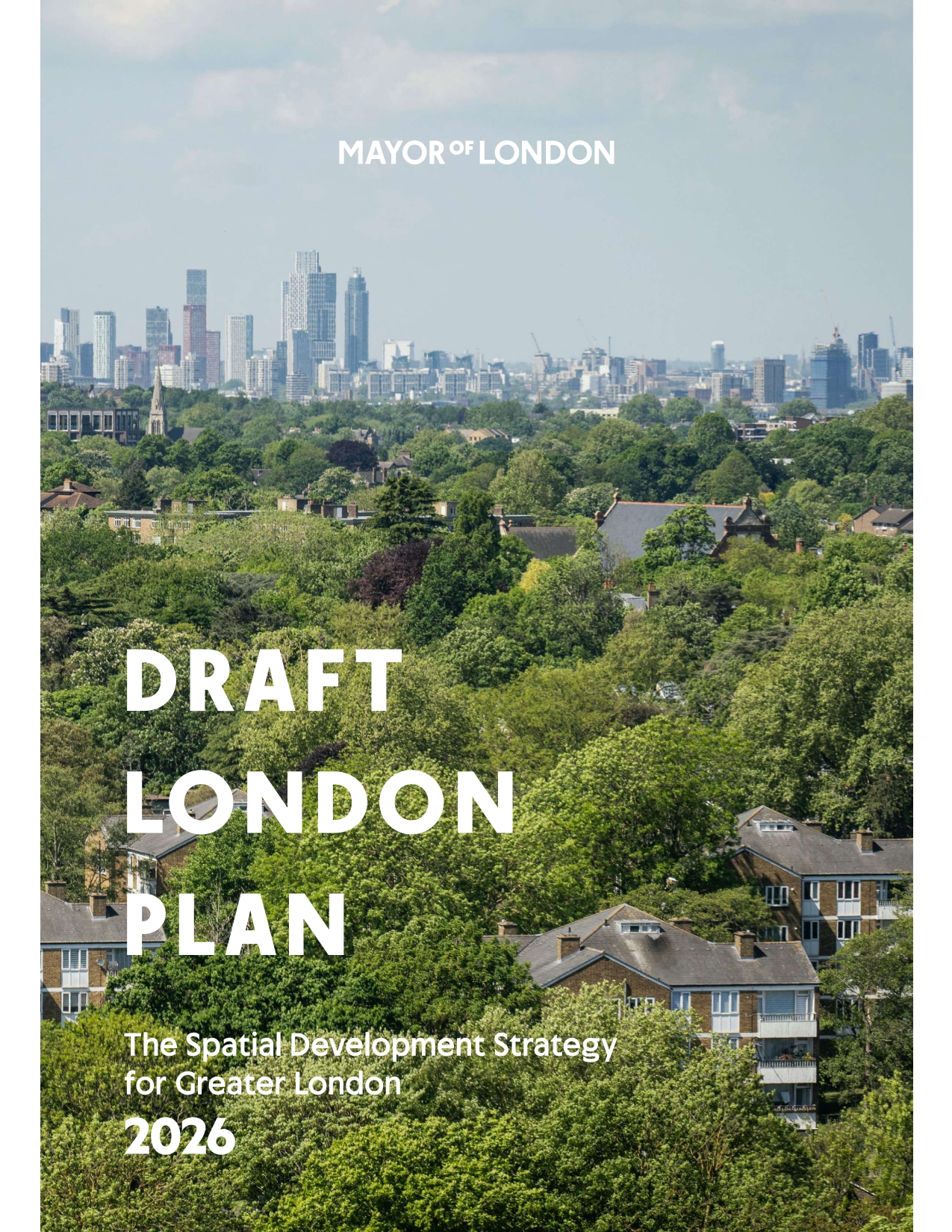
The Mayor of London has now published the draft London Plan for consultation, providing the first detailed look at the strategic planning framework that could shape development across the capital over the next two decades. Published on 16 July 2026, the draft Plan represents a significant departure from its predecessor, reducing in length from 542 pages to approximately 310 pages as part of the Greater London Authority's commitment to create a more streamlined and accessible planning framework.
Thank you for getting in touch. We will be in contact shortly.
Back in June, DHA Planning attended the London Planning Conference 2026 and examined the emerging direction of travel for the next London Plan in our article,'Next London Plan: Key Takeaways from the London Planning Conference 2026'. Many of the themes discussed at that event have now been translated into draft policy, including a greater emphasis on housing delivery, development optimisation, economic growth, infrastructure planning and a more flexible approach to London's Green Belt.
While the consultation document is significantly shorter than the adopted London Plan, it introduces a number of potentially far-reaching policy changes which could influence how and where development comes forward across London in the years ahead. Below, we highlight some of the key proposals.
A recurring theme throughout the draft Plan is a shift away from simply accommodating growth towards actively directing it. The Mayor is proposing a more interventionist spatial strategy which identifies where future development should be focused and provides a clearer framework for growth across the capital.
The draft London Plan establishes a unified spatial framework comprising 30 Brownfield First Opportunity Areas, 9 Broad Locations for Growth, 6 Strategic Growth Corridors and 17 Strategic Tall Building Clusters. Together, these designations seek to direct investment and development towards locations that can support housing delivery, economic growth and infrastructure improvements.
This represents a notable shift from previous approaches, placing greater emphasis on actively managing where growth occurs rather than simply responding to development proposals as they emerge.
New Policy MBUL2 introduces a London-wide Optimisation Framework designed to make more effective use of land within existing urban areas.
The policy proposes minimum density expectations linked to accessibility and context, together with indicative height parameters intended to encourage more efficient use of land. In particular, the framework seeks to support higher-density and mid-rise development in appropriate locations whilst retaining a design-led approach to placemaking.
The Mayor's objective is to maximise the capacity of previously developed land before considering more expansive growth options elsewhere. For developers and landowners, this could create greater certainty around density expectations whilst supporting increased housing delivery in sustainable locations.
The draft Plan places renewed emphasis on the role that smaller development sites can play in addressing London's housing needs.
Alongside the proposed introduction of a Small Sites Design Code for sites below 0.25 hectares, the Mayor is seeking to reduce barriers to delivery through a revised affordable housing approach. Under the proposals, residential developments delivering between 10 and 35 homes outside the Green Belt would be able to utilise a fast-track process where 20% affordable housing is secured through a payment-in-lieu contribution.
This is intended to improve viability and provide greater flexibility for smaller housing schemes whilst continuing to secure affordable housing benefits.
Perhaps the most significant and widely debated change is the draft Plan's approach to Green Belt land.
Whilst retaining a brownfield-first strategy, the Mayor now acknowledges that brownfield capacity alone is unlikely to meet London's long-term housing and economic requirements. As a result, Policy PV7 introduces a framework for the strategic release of selected Green Belt sites, focused primarily within outer London boroughs.
The draft Plan suggests that Green Belt release could contribute towards the delivery of approximately 56,000 homes through high-density, well-connected developments. Broad Locations for Growth have been identified to support this approach, with strict requirements relating to accessibility, infrastructure provision, landscaping, affordable housing and environmental enhancement.
Although any release would remain plan-led and subject to detailed assessment, this represents one of the most significant policy shifts within the draft Plan and is likely to be a key focus of consultation responses.
The Mayor's strategic objective of delivering 50% affordable housing across London remains unchanged. However, the draft Plan proposes a fundamentally revised threshold approach.
Rather than applying a consistent threshold across London, affordable housing requirements would be linked to locational bands reflecting differences in land values and viability across boroughs. Thresholds of 20%, 25% and 35% are proposed across outer, middle and inner London locations respectively.
Additional thresholds are also proposed for specific categories of development. Green Belt sites would be required to deliver either 50% or 35% affordable housing depending on the route pursued, whilst industrial land release would be subject to a 35% threshold and public sector land would be required to provide either 40% or 25%.
The draft Plan also introduces a revised fast-track route for smaller sites, providing further flexibility within the affordable housing framework.
Policy PV2 proposes a revised approach to London's Central Activities Zone (CAZ).
The policy distinguishes between a 'Core CAZ', where commercial, cultural and strategic business functions remain the primary focus, and a 'Mixed CAZ', where there may be greater opportunities for residential development alongside commercial uses.
This reflects growing recognition of the need to create more flexible and diverse city-centre environments whilst continuing to protect London's role as a global business destination.
The draft Plan continues to support affordable workspace provision but introduces greater flexibility in how it is delivered.
Under revised Policy GLE7, affordable workspace may be provided on-site, off-site, or through a financial contribution to a local planning authority's affordable workspace fund. This broadens the delivery mechanisms available to applicants and may assist in addressing viability constraints whilst continuing to support local businesses and start-ups.
Alongside housing delivery, the draft Plan places considerable emphasis on strengthening London's competitiveness and supporting sectors considered critical to the capital's future prosperity.
A key shift is the move from passively managing economic growth towards actively directing it. The Plan identifies emerging sectors such as artificial intelligence, life sciences and green data centres as strategic priorities, while seeking to maintain London's position as a global centre for innovation, employment and investment.
The proposals also aim to streamline planning barriers to growth while balancing commercial viability with environmental and social objectives.
Environmental sustainability remains central to the Mayor's vision, although the proposed policy mechanisms have evolved.
Policy GHR1 introduces Energy Use Intensity (EUI) and Space Heating Demand (SHD) standards, including both baseline and aspirational performance measures. These metrics are intended to place greater emphasis on actual building performance and energy efficiency outcomes.
Notably, the draft Plan no longer proposes the continuation of the current carbon offsetting approach, representing a significant departure from previous London Plan policy.
The draft Plan also introduces a stronger emphasis on the role of heritage assets in delivering sustainable growth.
A new heritage policy recognises that the adaptive re-use and retrofit of historic buildings can contribute towards housing delivery, regeneration and carbon reduction objectives. The policy seeks to support the continued use and repurposing of heritage assets whilst respecting their significance and character.
This reflects the increasing importance of retrofit-led development and the contribution that existing buildings can make towards London's wider net-zero ambitions.
Consultation on the draft London Plan runs until 15 October 2026, after which the document will be subject to examination before a final version is adopted.
Whilst the policies may evolve through the consultation process, the direction of travel is clear. The Mayor is seeking to create a planning framework that supports greater housing delivery, unlocks growth opportunities, strengthens economic competitiveness and responds to London's changing environmental and infrastructure challenges.
With significant implications for developers, landowners, local authorities and investors, the draft London Plan is likely to shape planning decisions across the capital for years to come.
The draft London Plan introduces significant changes to the planning policy framework across the capital, with potentially far-reaching implications for developers, landowners, investors, public sector organisations and local authorities.
Whether you are seeking to understand how the proposed policies may affect a development opportunity, review the implications for land holdings, or prepare representations as part of the consultation process, DHA Planning can help.
To discuss the draft London Plan and how it may affect your interests, please contact DHA Planning's Louise Overton or Sascha Wardley.
Thank you for getting in touch. We will be in contact shortly.