News
Monday August 3 2026
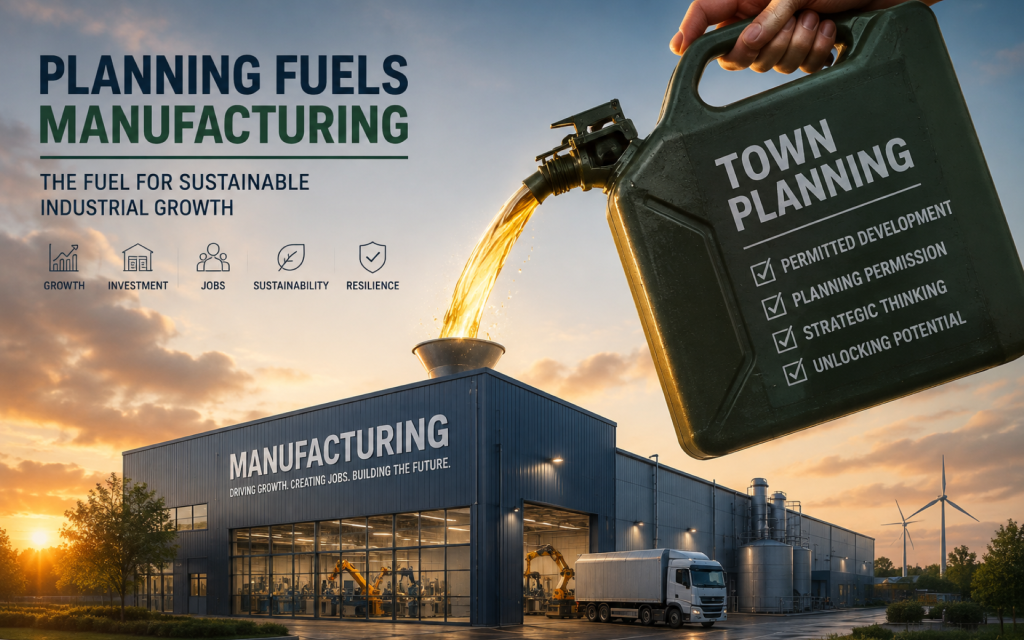
Planning Fuels Manufacturing
If Manufacturing is the Engine of Growth, Planning is the Fuel
The Government has made economic growth its number one priority. At the heart of that ambition sits manufacturing. Through its Industrial Strategy, the Government is seeking to drive investment in advanced manufacturing, clean energy technologies and other high-value industries that can boost productivity, create jobs and strengthen the UK's economic resilience.
However, growth is not just about investment. Manufacturers need the ability to expand, adapt and make better use of their sites. For many businesses, whether that happens quickly or becomes delayed by years of uncertainty can depend on a single factor: planning.
Recent manufacturing data suggests that, despite ongoing global economic pressures and supply chain challenges, the sector continues to grow, albeit at a more modest pace than many businesses would like. However, a fundamental question often receives far less attention:
Can the planning system keep up?
Planning is frequently discussed in the context of housing delivery and major infrastructure projects, yet it also plays a crucial role in supporting business investment and economic growth.
For manufacturers, logistics operators and corporate occupiers, the planning system can be a key factor in determining whether investment programmes are delivered quickly and efficiently or become delayed by uncertainty and prolonged timescales.
A recent report by Make UK titled 'Unblocking Growth', highlights that 46% of manufacturers believe the planning system restricts the UK's economic potential, with 48% citing regulatory complexity, 44% citing compliance costs, and 38% noting inconsistent local decisions as primary investment barriers.
For many businesses, growth is not necessarily about relocating to a new site. More often, it is about making better use of the land and buildings they already occupy.
This could include:
- Extending an existing factory or warehouse;
- Reconfiguring operational layouts to improve efficiency;
- Installing renewable energy infrastructure;
- Bringing forward underutilised areas of a site;
- Creating additional storage, production or distribution capacity; or
- Future-proofing a site to support long-term expansion.
The Opportunities Businesses May Be Missing
Many businesses are unaware that the planning system already contains mechanisms designed to support growth.
Depending on the circumstances, Permitted Development Rights can allow new industrial and warehouse buildings to be erected, or existing buildings to be extended without the need for a full planning application, subject to specific criteria and, in some cases, a prior approval process.
For businesses seeking to increase operational floorspace, these rights can provide a faster and more cost-effective route to development. Yet, in our experience, they remain significantly underutilised because many organisations simply do not realise the opportunities available to them.
Even where a full planning application is required, early planning input can often identify solutions that minimise risk, improve certainty and accelerate project delivery.
Planning Should Be Considered Earlier
Too often, planning is only considered once an investment decision has already been made.
We believe it should form part of the conversation much earlier.
Understanding what a site can accommodate, where constraints exist and what opportunities could be unlocked, including whether Permitted Development Rights may apply, gives businesses greater confidence before committing significant capital expenditure.
Early planning advice can help businesses understand:
- The development potential of their existing property portfolio;
- Constraints that may influence future growth plans;
- Opportunities to optimise operational land holdings;
- The likely planning route for development proposals; and
- How future expansion can be incorporated into longer-term business strategies.
Planning as a Strategic Business Tool
As the Government continues to focus on productivity, investment and industrial growth, planning has an increasingly important role to play.
It is no longer simply about obtaining planning permission.
It is about helping businesses invest, adapt and grow.
At DHA Planning, we believe corporate real estate should be viewed as a strategic business asset rather than simply an operational necessity. Businesses that regularly review the potential of their land and property holdings are often better placed to respond to changing market conditions, support investment decisions and capitalise on future opportunities.
If manufacturing is the engine of growth, planning is one of the fuels that will help power it.
Author

Alex Hicken MRICS
Managing Director
Alex has worked at DHA for more than 15 years and became Managing Director in 2016. Alongside overseeing the day-to-day running of the business, he remains passionate about planning and development.